Chapter 7: Graph + Vector
What Is It?
Vector search answers “which transactions look suspicious?” Graph traversal answers “which accounts are connected through circular money flows?” Used together, they answer a third question that neither can answer alone: “which suspicious-looking transactions are part of a coordinated fraud ring?”
This is the combination the book has been building toward. Every capability in the preceding chapters – graph traversal, full-text search, geospatial queries, temporal reasoning, document properties, vector search – was a standalone tool. Chapter 7 brings two of the most powerful together in a single Cypher query: a vector similarity search that identifies semantically suspicious transactions, followed immediately by a graph traversal that checks whether those transactions form a circular ring pattern.
The result is a fraud detection system with three operational modes. Pure graph ring detection finds coordinated circular money flows using Cypher pattern matching. Pure vector search finds transactions whose prose descriptions resemble known fraud language. Graph + vector combined does both in a single query, surfacing only those suspicious transactions that also participate in a ring – a much stronger fraud signal than either approach alone.
When Would You Reach for It?
The graph + vector combination earns its place when your fraud signal has two components: semantic content (what a transaction is described as) and structural position (who sent it and to whom, and how those accounts are connected). Either component alone produces noise. Together they produce signal.
Reach for this pattern when:
- You have text or embeddings that can identify suspicious entities
- You have a graph that can validate whether those entities are structurally connected in a suspicious pattern
- You need to run both in a single query rather than two separate systems
- The false positive rate from either approach alone is too high for the use case
Financial fraud is the canonical application, but the same pattern applies to social network abuse detection, supply chain anomaly detection and any domain where suspicious behavior has both a semantic signature and a structural pattern.
The Use Case
We build a synthetic fraud detection system with 1,000 bank accounts and approximately 50,000 transactions. The vast majority of transactions are legitimate – ring transactions account for less than 0.3% of the data, mirroring real-world fraud rates. Hidden in the transaction graph are planted fraud rings of 3, 4 and 5 hops, each with amounts tightly clustered between $2,000 and $9,999 and each completing within 90 minutes.
The challenge is finding those rings without knowing in advance which accounts or transactions are involved.
The Data
The dataset is generated entirely in the notebook with a fixed random seed for reproducibility.
Accounts: 1,000 nodes with account_id, customer_name and risk_score properties. About 20% of account names are business names (LLC, Inc, Corp); the rest are personal names.
Transactions: ~50,000 total. Each has tx_id, amount, timestamp, is_fraud_ring (the hidden ground truth), description (a prose sentence) and embedding (a 384-element fastembed vector).
Fraud rings: planted in three sizes – five 3-hop rings (min amount $4,000), five 4-hop rings (min amount $3,500) and three 5-hop rings (min amount $3,000). Twenty additional random noise rings of 3-6 hops add realistic background complexity. Ring transactions are spaced 3-15 minutes apart within each ring, so the full ring completes within 90 minutes.
Transaction descriptions: ring transactions use templates that sound like structuring or layering: “Structured transfer of $X through intermediary account – round-trip pattern.” Legitimate transactions describe plausible purchases at fictional merchants.
The graph model is:
(:Account {account_id, customer_name, risk_score})
  -[:MADE]->
(:Transaction {tx_id, amount, timestamp, is_fraud_ring, description, embedding})
  -[:TO]->
(:Account)
Building the Application
Prerequisites
You’ll need a Neo4j Aura free-tier instance with the connection details stored as environment variables.
This chapter uses fastembed for embedding the transaction descriptions. fastembed downloads the BAAI/bge-small-en-v1.5 model (~23 MB) on first use and caches it locally. The model produces 384-dimensional embeddings and runs entirely locally – no API key required.
Loading the Embedding Model
from fastembed import TextEmbedding

embed_model = TextEmbedding("BAAI/bge-small-en-v1.5")

def get_embedding(text: str) -> list:
    return list(embed_model.embed([text]))[0].tolist()

EMBEDDING_DIMS = len(get_embedding("test"))  # 384
We call embed_model.embed([text]) with a list and take the first result. This is slightly less efficient than batch embedding but keeps the helper function simple. For the full 50,000 transactions we embed in batches.
Loading the Graph
We load accounts first, then embed and load transactions in batches of 500. The embedding step takes a few minutes for 50,000 transactions:
def embed_and_load_batch(session, batch):
    texts  = [r["description"] for r in batch]
    embeds = list(embed_model.embed(texts))
    rows   = [
        {**rec, "embedding": embeds[i].tolist()}
        for i, rec in enumerate(batch)
    ]
    session.run("""
        UNWIND $rows AS row
        MATCH (src:Account {account_id: row.source_id})
        MATCH (tgt:Account {account_id: row.target_id})
        CREATE (t:Transaction {
            tx_id:         row.tx_id,
            amount:        row.amount,
            timestamp:     row.timestamp,
            is_fraud_ring: row.is_fraud_ring,
            description:   row.description,
            embedding:     row.embedding
        })
        CREATE (src)-[:MADE]->(t)
        CREATE (t)-[:TO]->(tgt)
    """, rows=rows)
Each transaction is connected to two accounts: the source account via MADE and the target account via TO. This two-relationship pattern is what enables Cypher to traverse ring patterns using comma-separated MATCH clauses.
Creating the Vector Index
The vector index uses cosine similarity, which is appropriate for sentence embeddings:
session.run(f"""
    CREATE VECTOR INDEX transaction_embeddings
    FOR (t:Transaction) ON (t.embedding)
    OPTIONS {{indexConfig: {{
        `vector.dimensions`: {EMBEDDING_DIMS},
        `vector.similarity_function`: 'cosine'
    }}}}
""")
We poll until the index is ONLINE before running any similarity queries – index creation is asynchronous.
Query 1: Pure Graph Ring Detection
Cypher expresses a 3-hop ring as a comma-separated pattern that returns to its origin:
result = session.run("""
    MATCH (a1:Account)-[:MADE]->(t1:Transaction)-[:TO]->(a2:Account),
          (a2)-[:MADE]->(t2:Transaction)-[:TO]->(a3:Account),
          (a3)-[:MADE]->(t3:Transaction)-[:TO]->(a1)
    WHERE t1.amount >= $min_amount AND t1.amount <= $max_amount
      AND t2.amount >= $min_amount AND t2.amount <= $max_amount
      AND t3.amount >= $min_amount AND t3.amount <= $max_amount
      AND a1.account_id < a2.account_id
      AND a1.account_id < a3.account_id
      AND abs(duration.between(datetime(t1.timestamp),
              datetime(t2.timestamp)).minutes) < 90
      AND abs(duration.between(datetime(t2.timestamp),
              datetime(t3.timestamp)).minutes) < 90
    RETURN a1.account_id AS account_1,
           a2.account_id AS account_2,
           a3.account_id AS account_3,
           t1.amount AS amount_1,
           t2.amount AS amount_2,
           t3.amount AS amount_3
    LIMIT $limit
""", min_amount=min_amount, max_amount=max_amount, limit=limit)
Three filters work together to eliminate coincidental rings:
Amount range (min_amount to max_amount=9999): legitimate transactions go up to $50,000. Ring transactions are generated between $2,000 and $9,999. The upper bound eliminates the vast majority of coincidental cycles formed by legitimate high-value transactions.
Timestamp constraint (within 90 minutes): ring hops are spaced 3-15 minutes apart, so a 3-hop ring completes in at most 30 minutes. A 90-minute window catches all planted rings while eliminating coincidental cycles between transactions days apart.
Deduplication (a1.account_id < a2.account_id AND a1.account_id < a3.account_id): without this, every ring appears multiple times – once for each starting account. The alphabetic ordering constraint ensures each ring is returned exactly once.
One critical Cypher detail: the ring pattern uses comma-separated MATCH clauses, not juxtaposed patterns. Juxtaposing the patterns – writing them one after another without a comma – causes a syntax error in Neo4j 5.x. The comma is required.
The same structure extends naturally for 4-hop and 5-hop rings by adding one more account and transaction to the pattern. The equivalent SQL requires a completely rewritten recursive CTE for each additional hop.
Query 2: Pure Vector Search
Pure vector search embeds the query string and finds semantically similar transactions:
query_embedding = get_embedding("circular money transfer through intermediary accounts")

result = session.run("""
    CALL db.index.vector.queryNodes(
        'transaction_embeddings', $top_k, $embedding
    ) YIELD node AS t, score
    MATCH (src:Account)-[:MADE]->(t)-[:TO]->(tgt:Account)
    RETURN t.tx_id         AS tx_id,
           src.account_id  AS source_account,
           tgt.account_id  AS target_account,
           t.amount        AS amount,
           t.is_fraud_ring AS is_fraud_ring,
           t.description   AS description,
           score
    ORDER BY score DESC
""", embedding=query_embedding, top_k=top_k)
The vector search returns transactions whose descriptions are semantically similar to the query. Because ring transactions were generated with structuring and layering language, queries about circular money movement consistently return ring transactions with cosine similarity scores above 0.90. But pure vector search has no awareness of whether those transactions form rings – it can flag individual suspicious transactions without confirming the pattern.
Query 3: Graph + Vector Combined
The combined query runs vector search first, then immediately extends into graph traversal in the same Cypher statement:
result = session.run(f"""
    // Step 1: vector search finds semantically suspicious transactions
    CALL db.index.vector.queryNodes(
        'transaction_embeddings', $top_k, $embedding
    ) YIELD node AS t, score
    WHERE score >= $threshold

    // Step 2: get the source account of each suspicious transaction
    MATCH (a1:Account)-[:MADE]->(t)

    // Step 3: check if the target account is part of a ring
    {ring_match}
    WHERE {ring_where}

    RETURN DISTINCT
        t.tx_id         AS tx_id,
        score           AS similarity,
        a1.account_id   AS entry_account,
        t.amount        AS entry_amount,
        t.is_fraud_ring AS is_fraud_ring,
        {ring_return}
    ORDER BY score DESC
""", embedding=query_embedding, top_k=top_k, threshold=threshold,
     min_amount=min_amount, max_amount=max_amount)
The ring_match and ring_where strings are built dynamically based on the ring_hops parameter (3 or 4). For a 3-hop ring check, ring_match follows the target account through three MADE/TO hops back to itself; ring_where applies the amount and timestamp filters to those ring transactions; ring_return returns the list of ring account IDs.
This is the key result: only transactions that are both semantically suspicious (high cosine similarity to the query) and structurally connected (part of a circular ring pattern) appear in the output. The is_fraud_ring flag confirms against the hidden ground truth.
Ring Summary
A batch ring summary query counts all detected rings and confirmed fraud:
result = session.run("""
    MATCH (a1:Account)-[:MADE]->(t1:Transaction)-[:TO]->(a2:Account),
          (a2)-[:MADE]->(t2:Transaction)-[:TO]->(a3:Account),
          (a3)-[:MADE]->(t3:Transaction)-[:TO]->(a1)
    WHERE t1.amount >= 2000 AND t1.amount <= 9999
      AND t2.amount >= 2000 AND t2.amount <= 9999
      AND t3.amount >= 2000 AND t3.amount <= 9999
      AND a1.account_id < a2.account_id
      AND a1.account_id < a3.account_id
      AND abs(duration.between(datetime(t1.timestamp),
              datetime(t2.timestamp)).minutes) < 90
      AND abs(duration.between(datetime(t2.timestamp),
              datetime(t3.timestamp)).minutes) < 90
    RETURN count(*) AS ring_count,
           round(avg(t1.amount + t2.amount + t3.amount), 2) AS avg_total_amount,
           sum(CASE WHEN t1.is_fraud_ring = true THEN 1 ELSE 0 END) AS confirmed_fraud
""")
With the amount range and timestamp filters applied, this query returns 13 detected rings, all 13 confirmed as planted fraud – 100% precision. The ring summary is a full graph scan and runs slowly; it’s designed as a batch analytical query, not an interactive one.
Ring Visualization
Detected rings are visualized as a NetworkX force-directed graph rendered with Plotly. Red nodes (#E63946) represent accounts; grey edges show the direction of money flow. The spring layout with k=1.0 spreads the nodes organically without forcing rigid geometric shapes:
G = nx.DiGraph()
for r in ring_records:
    ring_nodes = [r[f"account_{i}"] for i in range(1, hops + 1)]
    for i, node in enumerate(ring_nodes):
        G.add_node(node)
        G.add_edge(node, ring_nodes[(i + 1) % hops], amount=r[f"amount_{i+1}"])

pos = nx.spring_layout(G, seed=RANDOM_SEED, k=1.0, iterations=100)
Figure 7-1 shows the detected 3-hop rings – each cluster of three nodes forms a circular money flow.
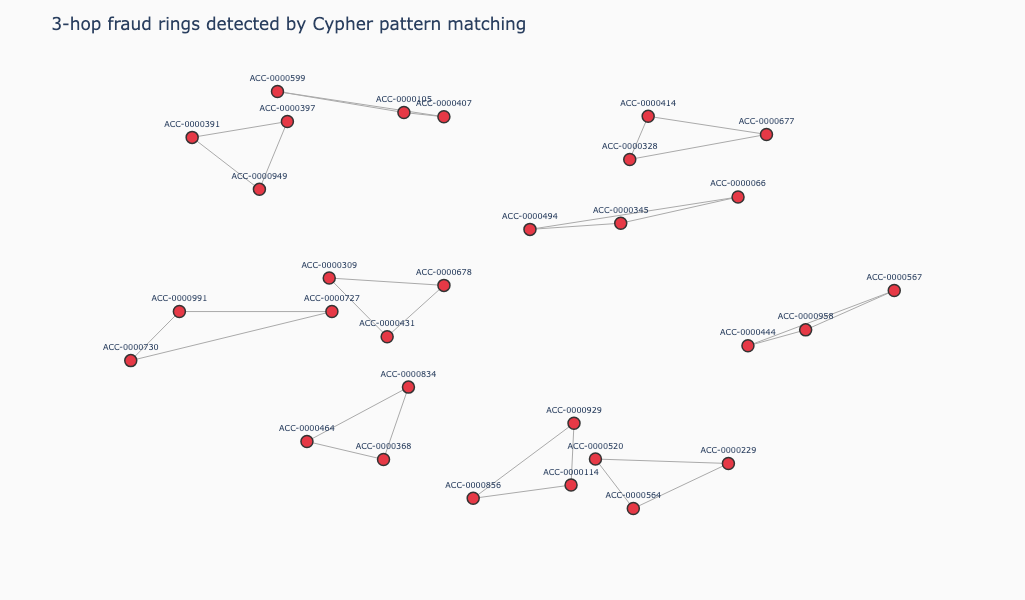
Figure 7-1. 3-hop Fraud Rings.
The Streamlit App
The sidebar has a query type selector – Pure Graph, Pure Vector, Graph + Vector – with parameters that adapt to the selection. Pure Graph exposes hop count (3, 4 or 5), min/max amount and a result limit. Pure Vector exposes a query text area, vector candidate count and similarity threshold. Graph + Vector exposes all of the above.
The app has two tabs. The Query Explorer tab runs the selected query and displays results as a dataframe – ring paths and amounts for pure graph, transaction details and fraud flags for pure vector and entry transaction plus ring structure for graph + vector. The Ring Visualization tab is active after a Pure Graph query and renders the spring-layout ring graph.
All results persist in st.session_state across re-runs. The embedding model is cached with @st.cache_resource so it loads once and stays in memory for the session – fastembed downloads are slow on first run but instant on subsequent ones.
What You’d Hit in Production
Embedding throughput. fastembed with BAAI/bge-small-en-v1.5 runs on CPU and embeds roughly 500-1,000 short sentences per second on a modern machine. For 50,000 transactions this takes a few minutes. For millions of transactions at ingestion time, batch embedding with a GPU or a hosted embedding API would be significantly faster.
The query parameter conflict. The Neo4j Python driver reserves query as a keyword argument for the Cypher string itself. Never use query as a parameter name in your Cypher parameters. Use search_query, embedding, q or any other name. This applies everywhere in the codebase, not just chapter 7.
Ring summary performance. The ring summary query scans the full transaction graph. On 50,000 transactions it takes 10-30 seconds. For production workloads you’d run this as a scheduled batch job rather than on demand, and consider creating additional indexes to speed up the traversal.
The max_amount filter. Without the upper-bound amount filter (amount <= 9999), legitimate transactions with amounts up to $50,000 form thousands of coincidental 3-hop cycles. The amount ceiling is not an arbitrary threshold – it’s grounded in the dataset design. In a real system you’d tune this threshold empirically based on the known amount distribution of your fraud cases.
Comma-separated MATCH patterns. Neo4j 5.x requires comma-separated MATCH clauses for multi-hop ring patterns. Juxtaposed patterns – written one after another without a comma – cause a syntax error.
Going Further
This chapter closes the arc the book has been tracing. We started with the graph model in chapter 1 – stations, connections, traversal. We added capability by capability: text search, spatial queries, temporal data, document properties, vector similarity. Chapter 7 combines the last two into something that neither graph databases nor vector databases can do alone in a single query.
The fraud detection system in this chapter is a demonstration, not a production deployment. A real system would need continuous ingestion, a real-time embedding pipeline, alerting thresholds calibrated against labeled historical data and human review of flagged cases. But the core pattern – vector search to identify candidates, graph traversal to validate structure – is the right architecture for this class of problem, and Neo4j is the right database to run it on.
That’s Neo4j beyond the graph.